
'For the next two years, we expect the bulk of earnings growth contribution from sectors like financials and energy, where the outlook remains positive, while the sectors which are linked to domestic consumption and are currently witnessing strains on margins have low salience for Nifty earnings.'

The Reserve Bank of India (RBI) on Wednesday announced to increase the policy repo rate by 50 basis points to 4.9 per cent, the second hike in five weeks aimed at quelling the inflation. The MPC vote was unanimous and has decided to keep stance withdrawal from accommodative, RBI Governor Shaktikanta Das said in a press conference on Wednesday. The decision was taken during a three-day meeting of the RBI's Monetary Policy Committee (MPC) to review the interest rates in the country. The MPC voted unanimously to increase the policy repo rate by 50 bps to 4.90 per cent," Das said.

This means lower losses on fuel sales by Indian oil companies and a shrinking oil subsidy bill for the government.

The world economy is going through a tough phase.

On February 24, when Vladimir Putin announced a military operation on Ukraine, few would have thought that Indian government-owned GAIL India would feel the impact. The tensions over gas supplies were essentially a Europe-Russia problem, related to the sanctions western economies imposed on Moscow. But the EU depends on Russian imports for 40 per cent of its gas stocks, an over-dependence that Russia has underlined with Kremlin-owned Gazprom cutting its supplies through the Nord Stream 1 pipeline to 20 per cent, citing maintenance issues.

Jaishankar said all members would agree that India's approach should be guided by its national beliefs and values, national interest and by its national strategy.

Experts caution against tough times in Indian equity markets in 2015.
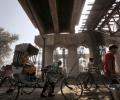
'The government must keep bad news out of the newspapers. If you have news about a fight everyday, it is not a climate where investment takes place.'

So which sectors are likely to do well in 2022? Should you focus on domestic economy-related sectors or export-oriented ones?

What are the most worrisome aspects of climate change for India? Can they be solved?

'Periods of high volatility are usually bad for mid-caps and this is something that has to be kept in mind.' 'Focus on quality is of paramount importance.'

'India easily remains one among the more attractive large economies, with high growth and stable/improving macros, as a top investment destination.' 'We are looking pretty good.'

Russia dominated Saudi Arabia in oil supplies as the world's fastest-growing major economy for fossil fuels in October, relegating the Kingdom to third place. Iraq was India's top oil supplier, according to the data from Vortexa. Saudi Arabia's decline in India's oil market has coincided with Russia's rise, and ironically occurred amid growing diplomatic ties between Riyadh and New Delhi. Saudi Crown Prince Mohammed bin Salman Al Saud is visiting India this month to meet Prime Minister Narendra Modi.
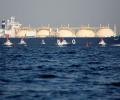
The government should bring natural gas under the Goods and Services Tax (GST) regime to realise Prime Minister Narendra Modi's vision for a gas-based economy and raising the share of the environment-friendly fuel in India's energy basket, an industry body that represents the likes of Reliance Industries as well as state-owned firms, has said. Natural gas is currently outside the ambit of GST, and existing legacy taxes -- central excise duty, state VAT, central sales tax -- continue to be applicable on the fuel. In its pre-Budget memorandum to the finance ministry, Federation of Indian Petroleum Industry (FIPI), which boasts of members from across the oil and gas spectrum, also demanded rationalisation of GST on transportation of natural gas through pipeline as well as on re-gasification of imported LNG to help bring down cost of the environment friendly fuel.

The world economy will consume in the next five years far less oil than previously assumed, the western countries' energy watchdog said on Friday in a further sign of the impact of the global economic crisis on commodities markets.
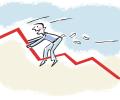
Amid slowing growth and low interest rates, investors will need to focus on stock-picking, suggests John Remmert.

Reliance Industries on Friday reported a 41.5 per cent jump in its third quarter net profit as oil, retail and telecom businesses fired on all cylinders. Net profit of Rs 18,549 crore in October-December compared with Rs 13,101 crore a year back, the company said in a stock exchange filing. Income from operations rose to Rs 1.91 lakh crore from Rs 1.28 lakh crore.

'We would like to develop Andhra Pradesh into a logistics hub not only for India, but also for South Asia.'

Wood Mackenzie projected India's real GDP level to overtake Japan and reach over $6 trillion by 2035.
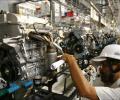
India's economy grew at 7.6 per cent in 2015-16.

Shaktikanta Das said in Washington, DC, that there was nothing sacrosanct about the 25 bps rate cut and that monetary policy could be well served by calibrating the size of the policy rate to the dynamics of the situation, and the size of the change itself could convey the stance of policy.

'An internationally established price of crude will encourage more players to invest in India, leading to enhanced domestic production which can be made available to domestic refineries,' recommends Anil Agarwal whose company Vedanta Resources has a controlling stake in Cairn India that operates the country's biggest onland oilfield in Barmer, Rajasthan.

This was the near-unanimous replies of 10 market participants.

Investor wealth plummeted by nearly Rs 5 lakh crore in early trade on Monday as equity markets crashed tracking global equity selloff amid rising uncertainty over the economic impact of coronavirus outbreak. Market capitalisation (m-cap) of BSE-listed companies saw a massive decline after the 30-share index plunged 1515.01 points, or 4.03 per cent, to 36,061.61. The NSE Nifty too cracked 417.05 points, or 3.80 per cent, to 10,572.40.

We have our own problems for sure and they are not trivial, but for now, our economy is in not too bad a shape, our politics is as personality-driven and authoritarian as that of most countries in the world. We must make the best of what we have and not be excessively unhappy looking at the grass on the other side of the septic tank which may not be greener after all!, observes Shreekant Sambrani.

'It is less dependent on imported capital.'
Amidst the expectations game for the ongoing elections, stock markets seem to be overlooking one fact, which to us is of significance, i.e. rising crude prices.

Whatever be India's course of action, it will have an impact on India-Iran ties, notes Aveek Sen.
In the near term, the key driver will still be the government's fiscal spending.

The vaccination rate needs to go up by three to four times, assert Ajay Shah and Amrita Agarwal.

'In the short term, we may see some disruptions due to Covid, but in the medium-to-long term, we should keep an eye on US inflation and 10-year bond yields.'

China, it said, is projected to grow at 6.6 per cent in the current year which will moderate to 6.4 per cent next year.

New Delhi says existing food stocks will be sufficient to contain any food price shock.

Steep taxes on petrol and diesel add to the cost of economic activity and reduce the Indian economy's competitiveness. The two fuels must be brought under GST's purview, suggests former IAS officer Ajay Shankar.

The 30-share BSE Sensex surged by 477.24 points or 0.83 per cent to close at more than one-week high of 57,897.48. As many as 28 of its constituents closed with gains while two declined. The broad-based Nifty of the National Stock Exchange rose by 147.20 points or 0.86 per cent to settle 17,233.45, tracking gains in Sun Pharma, Asian Paints, and Reliance Industries.

'For equities, inflation trending upwards but within the range of expectations can actually be a big positive as it helps earnings and may shift flows from bonds to equities.'

China's GDP grew by 4.9 per cent in the third quarter, down from 7.9 per cent in the second, confirming the slowdown of the world's second-largest economy which was under pressure from the crisis-hit property sector, curbs on energy and tardy recovery from the Covid-19 pandemic.


American refiners closed some of their production, leading to futures trade benchmarked to the West Texas Intermediate going negative.
